
Artificial
University
The Effects of AI on a Clerical
and Technical Labor Union

The tech industry markets Artificial Intelligence (AI) as a transformational technology for nearly all aspects of life. But while AI companies’ research and political advocacy help boost the valuation for shareholders, AI’s advocates and advertising consistently omit the critical voice of workers who do the jobs in which rapid AI adoption is taking place. Local 34-UNITE HERE’s latest report is a first step toward filling that gap.
Artificial University documents the effects of generative AI on Local 34-UNITE HERE, a clerical and technical workers union representing 3,933 workers at Yale University in New Haven, Connecticut.
This research suggests that AI adoption will not result in a singular ‘doomsday event.’ Instead, this report finds that AI has started to produce a slow, steady attrition of middle-class clerical work through “passive automation,” a process by which companies, universities, and governments will deploy AI to do more administrative labor without needing to rehire workers who have quit or retired.
Key Findings
While Yale claims AI use is not mandatory, many workers experience consistent pressure from managers to be trained on and to use AI.
AI has led to profound changes in the fields of grant writing, memo writing, email outreach, customer service, information retrieval, and many other tasks that Local 34-UNITE HERE members do on a regular basis.
By rushing to implement AI, the Yale Administration violated a legal duty to involve clerical and technical workers in their AI roll out.
In some cases, AI implementation has made clerical and technical work less efficient, rather than more, and AI-driven errors have sometimes reduced the quality of service delivered to the Yale community.
Using our membership metrics, this report shows that Local 34-UNITE HERE membership has started to shrink fast in the last year.




AI at Yale
In 2024, Yale University invested $150 million into developing its AI program and launching its own proprietary generative AI wrapper, Clarity. Administrators have pushed for AI in many different ways across campus, substantially changing union members’ work.
In March 2025, Local 34-UNITE HERE ran a membership-wide survey ahead of negotiations for the terms of the 2027 contract, which received a total of 2,455 responses. When asked whether AI or Automation was in use in their departments, 719 members indicated “Yes” (29%).
Local 34-UNITE HERE members’ firsthand experiences with the rollout and use of AI at the University is essential to understanding the impact of this new technology on workers.

While Yale claims AI use is not mandatory, many workers experienced consistent pressure from managers to be trained on and use AI. In some cases, managers have asked workers to ask Clarity before coming to them with questions.

Dana Greene, a Senior Administrative Assistant in the School of Public Health, reported consistent encouragement from management to use more AI in her work. Greene’s manager required Greene and the rest of her department to attend a mandatory team meeting for “AI Training” led by a System and Application Specialist at Yale held on October 29, 2025.
During this meeting, my manager had staff work through potential use cases of AI in their work, such as using it for emails, generating meeting notes, using it for questions as pertaining to Excel usage, and various other job responsibilities. After this meeting, my manager would encourage staff to use AI in biweekly meetings at a rate of once per every two meetings.
In one-on-one meetings between my manager and me, my manager encouraged me to use AI for questions that I would address toward her. For example, I was encouraged to use Clarity to review Yale’s policies and procedures regarding departmental travel. This is a question that I would have previously sought guidance on from my manager. Instead, my manager encouraged me to use AI to find the answer to this question first. Encouragement regarding AI use from my manager would happen on a regular basis.
Encouraging employees to consult AI before asking their manager for help on a task presents a host of possible issues. For instance, who would be responsible for a costly error in booking travel if a clerical worker was told to ask AI for information and the AI gave them faulty information? Lack of proper managerial oversight due to the introduction of AI puts clerical and technical jobs at risk and the University has not yet implemented any protections for workers who make errors due to AI outputs. It also runs the risk of creating costs that far outweigh the benefit of saving a few minutes on communication.
In the Yale Office of Development, a union member who wants to remain anonymous due to fear of retaliation, reported experiencing a departmental culture shift after the release of Clarity. In their unit, which coordinates stewardship of Yale University donors, the worker was directed to incorporate it into as many responsibilities as possible.
By April 2025, AI use was not only encouraged, but a mandatory and non-negotiable part of my job. At this point, my manager had put me in touch with.... the AI Community of Practice group, which was working on a department-wide “AI Best Practices” resource... In this email, I was encouraged to share how I have used AI to automate parts of my job that I had previously done by hand... [This group] was especially interested in my ability to use Clarity to edit text in a spreadsheet before uploading it to [another tool] that I use for my work in Development.
The pressure to use AI is so intense, this worker shared, that the Department has incorporated AI competency into the requirements sections of its job ads.
New hires in our department are expected to be extremely fluent in AI, according to job postings…A recent ad for [a Local 34 position in my department] openly states that the desired candidate “successfully engages with the university’s AI platforms to enhance productivity as it relates to data analysis” and “liaises with other units and vendors to maintain/enhance software platforms, including our AI models.”
AI has led to profound changes in the fields of grant writing, memo writing, email outreach, customer service, information retrieval, and many other tasks that Local 34-UNITE HERE! members do on a regular basis.

One union worker in the Development Office, Tamera Sternberger, described how her job has been fundamentally altered by the incorporation of AI in her department. She reported that prior to the implementation of AI, she was responsible for a significant amount of writing tasks on solicitation campaigns.
Before Fall 2025, I would be part of large email solicitation campaigns to donors at Yale College, hands-on with drafting, writing, editing, and multiple draft revisions. In most cases, this fundraising work would entail multiple revisions with my manager and would take several weeks of work to complete. Following the introduction of AI in the Development Office, I am now rarely asked to do any drafting, editing, or revision, since this work is now almost exclusively done by AI by my managers.
Instead, she is now responsible for organizing and executing the logistics of student-facing events: moving things, bringing equipment and materials to the rooms where the events are happening, and so on— things Clarity cannot do. This is not the job she was hired for, noting that the “creative parts” of their job have been “automated away.”

Carolyn Kyrtopolous, Senior Administrative Assistant 2 in the Dean’s Office of the Faculty of Arts and Sciences, said she became aware of Clarity in September 2024 at a Faculty of the Arts and Sciences Dean’s Office meeting, and subsequently had to go through a series of staff meetings and training sessions on how to use AI in her work.
In parallel to these large department-wide meetings, AI use was also being encouraged in smaller team meetings during the 2024-2025 academic year… In one such meeting, [my manager] projected his screen through a monitor and trained us on how to use Clarity to write scholar biographies.... He used [this] biography as a test-case for how to generate a biography in different tones, styles, and lengths with Clarity. Writing a biography by hand is time consuming work, and usually takes approximately two hours per biography. Now, with the use of Clarity, each biography could take a fraction of the time, and four biographies could be completed in the span of two hours of work for one [clerical and technical worker].
Management, and specifically [my direct manager], have also introduced technology to greatly accelerate the speed at which staff write various letters, including those letters that we write for appointments, promotions, and job offers. …. While letter-writing is not a large part of my job, my coworkers (who are also Local 34-UNITE HERE members) write hundreds of letters in a semester, and have had their work significantly affected by this change.
Writing biographies and letters are a major part of the work that Local 34-UNITE HERE members do on a regular basis. These letters and biographies are often components of extraordinarily significant events for members of the Yale and broader academic community and serve as communications on breakthroughs in the University’s core mission of research and teaching. Local 34-UNITE HERE members understand the significance of these events and have often formed personal relationships and a stake in the success of the subjects of the letters and biographies. This personal connection is removed with AI-generated text.
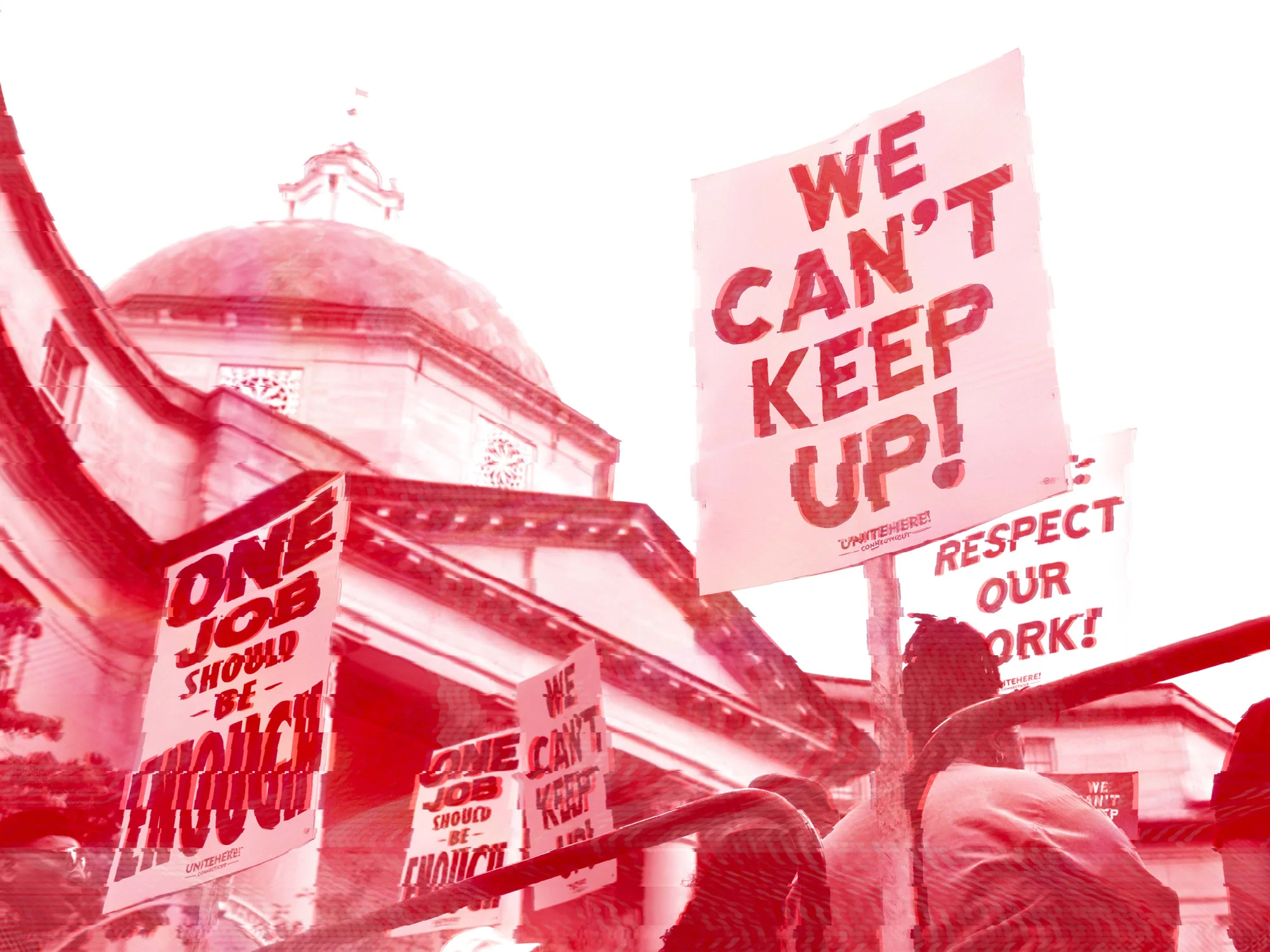
The value of AI in the workplace is uneven across different types of work. In some cases, AI implementation has made clerical and technical work less efficient and AI-driven errors have reduced the quality of service delivered to the Yale community.
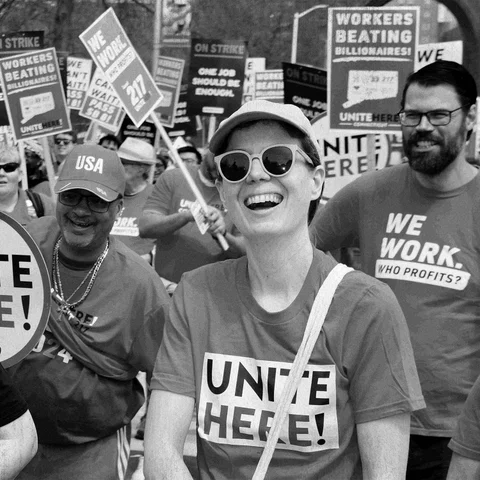
Local 34-UNITE HERE Member Jennifer Ongley, Assistant to the Chair in the Department of Physics, reported that she does not use AI on ethical grounds but it still impacts her work.
Despite not wanting to use AI, AI is nevertheless present in many aspects of my job. Management told us during staff meetings that they were being pushed by University administration to encourage staff to use AI more in our work. In particular, management suggested using AI to edit our emails and other written communications, to take meeting notes, and to try the University’s new AI chatbot. This was intended to improve clarity and conciseness in our writing as well as save time and make us more efficient.
While some of my coworkers also try to avoid AI, others started using it to draft materials which they then ask me to review. For example, a colleague asked me to edit a document she wrote with AI that was supposed to provide instructions for admitted students to book their own travel for a campus visit. I was frankly appalled at the document she shared with me. Instead of clearly laying out the specific travel options, it was a confusing jumble of word salad that somehow said very little while using way too many words. I gave up after making a few edits to the first page and sent it back to my colleague with the suggestion that she scrap it and start from scratch on a new draft, exactly the thing she was trying to save time on by using AI.
Other colleagues have also sent me emails they edited with AI alongside their original draft for comparison; the AI-edited ones are all unequivocally worse than the original versions. Another colleague experimented with using AI to draft event posters. While the AI helped with some aspects of design, it also introduced errors that she was unable to remove. She ultimately had to start drafting a new poster from scratch, doubling the amount of time it took her to complete the task.
Kyrtopolous had a similar experience with AI making work less efficient.
AI use was also consistently encouraged by [my manager] for a particularly complicated and time-consuming scheduling task. This scheduling task involves coordinating around 40 or so [calendars], and usually takes several dozen hours for about three administrators to complete. I was now tasked with completing this task entirely by myself. In several one-to-one and group meetings, [my manager] encouraged me to use AI to complete this task, even instructing me in one meeting on how I can complete this scheduling task by plugging the spreadsheet into Clarity. While Clarity failed to complete the task to the required specification, [my manager] again brought up using Clarity to do this scheduling task for next year’s annual meetings in a team debrief in the Spring of 2025. Several other Local 34 [members], including myself, were present in this debrief, and pushed back on [my manager’s] impression that AI could do this task effectively. It is likely that I will be encouraged to use Clarity to complete this task again in the future.
Local 34-UNITE HERE!
Is shrinking. Fast.
While it would be nice to believe that automating significant portions of a Local 34-UNITE HERE member’s job will free up their time to do more interesting and creative work, that is not what usually happens during periods of worker automation. As seen from industrial labor, job automation typically destroys the job market of the work that is automated, forcing unemployed workers to find new lines of work.i
This has already started to happen. Clarity was released on August 28, 2024, with widespread adoption by the summer months of 2025, which is when Yale’s program to train workers on AI became more aggressive. Local 34-UNITE HERE membership grew until April 2025, at which point the size of the union peaked at 4,112 members. Anticipating an endowment tax by the federal government, Yale implemented a 90-day hiring freeze in June 2025.ii Beginning in April 2026, Yale implemented a retirement incentive. Yale’s administration fiercely resisted Local 34-UNITE HERE’s attempt to secure a minimum staffing floor to preserve the size of the union.iii As expected, the size of the union began to decline in May 2025 and dropped off sharply over the course of the following four months, the first major downturn in membership since 2020. By supplementing a smaller workforce with AI, the University can simply avoid hiring workers to replace those who have retired or have quit, reducing the amount of union work needed to fulfill the same amount of work that was done previously.
As AI continues to transform white-collar work, workers should band together to have a bigger say in the future of office work in this country. Unions must play an important role in developing innovative ways to respond to and mitigate against the automation crisis of AI.
Despite the clear and immediate ways the rollout of Clarity would change the jobs of Local 34-UNITE HERE members, the University made no attempt to contact Local 34-UNITE HERE or engage in impact bargaining about AI as it pertains to the unionized workers at the University. Yale’s initiative to roll out Clarity to the University community without giving Local 34-UNITE HERE 90 days’ notice violated the terms of the Local 34-UNITE HERE 2022 Memorandum of Agreement (MOA), and cost the opportunity to improve its implementation with the input of line workers.
Employers like Yale University have a vested interest in collaborating with workers to avoid unnecessary hardship for the community and to give workers more say over the use of technology in their workplace. If solutions are acted on now, any transition to AI will cause less hardship and can mitigate the effects of worker automation. Pay increases pegged to the productivity increases that come with AI, along with better labor protections that protect against job loss and are achieved through collective bargaining and political action, will be essential to protecting good, middle-class jobs in America and abroad.
Endnotes
i Claire Cain Miller, “The Long-Term Jobs Killer is not China. It’s Automation.” The New York Times, Dec. 21, 2016, archived at http://web.archive.org/web/20170209053430/https://www.nytimes.com/2016/12/21/upshot/the-long-term-jobs-killer-is-not-china-its-automation.html
ii Isobel McClure and Henry Liu, “Yale Pauses Hiring, Tightens Budget in Anticipation of Endowment Tax Hike,” Yale Daily News, June 30, 2025, https://yaledailynews.com/articles/yale-pauses-hiring-tightens-budget-in-anticipation-of-endowment-tax-hike
iii Isobel McClure and Henry Liu, “Yale Pauses Hiring, Tightens Budget in Anticipation of Endowment Tax Hike,” Yale Daily News, June 30, 2025, https://yaledailynews.com/articles/yale-pauses-hiring-tightens-budget-in-anticipation-of-endowment-tax-hike